If you are a founder in Lahore, Karachi or Islamabad, or a business in Dubai or the US looking at Pakistani developers, you have probably seen app quotes that range from “PKR 80,000” to “$80,000” for what sounds like the same idea. Both can be honest. They are usually not quoting the same app.
This guide gives you real price bands in PKR and USD, explains where they come from, and shows what to check before you sign. Every hard number links to a source or is clearly labelled as an estimate.
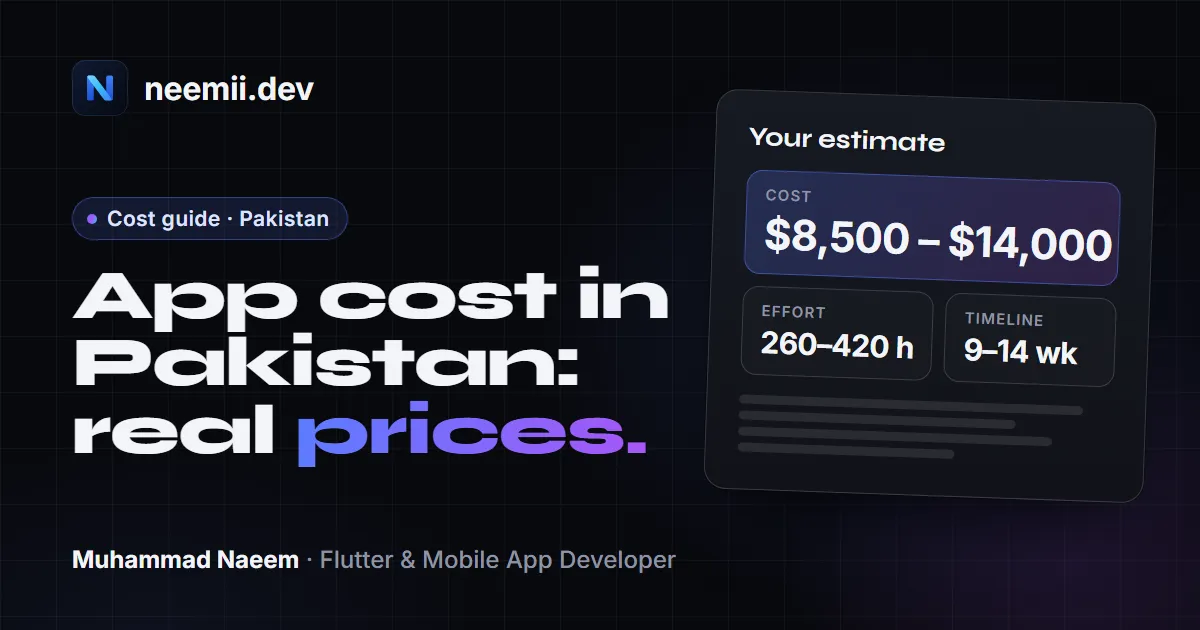
Quick answer: In 2026, a simple mobile app built in Pakistan costs roughly PKR 1–6 million ($4,000–$22,000), a medium app with payments and an admin panel roughly PKR 2.5–14 million ($9,000–$50,000), and a complex app such as ride-hailing or a marketplace roughly PKR 6–35 million ($21,000–$125,000). Freelancers sit at the lower end of each range, software houses at the higher end. These are estimates from typical hours × Pakistani rates, not fixed quotes.
Exchange rate used: about PKR 277 per USD, based on the interbank close of PKR 276.62 on November 11, 2026. PKR figures are rounded. If the rupee moves, the USD figures are the more stable reference, because most Pakistani developers and software houses price foreign work in dollars.
How the price is calculated
Every app quote, whether it is written that way or not, comes down to hours × hourly rate, plus running costs after launch.
The hours come from the scope. I use the same planning ranges as in my global guide to Flutter app development cost. They are assumptions for a Flutter app on iOS and Android, including design, backend, testing and store launch:
- Simple app: 250–450 hours. 5–10 screens, login, profile, content lists, a managed backend such as Firebase, push notifications, no payments.
- Medium app: 600–1,000 hours. 15–30 screens, two user roles, a web admin panel, payments or subscriptions, and one heavier feature such as maps, chat or a third-party API.
- Complex app: 1,400–2,500 hours. 30+ screens, several user roles, real-time chat or live location, a custom backend, a full admin panel and several integrations.
The rate depends on who builds it.
Hourly rates in Pakistan
There is no official, Pakistan-only survey of mobile developer rates. These are the best public data points I could find:
| Who | Typical rate | Source |
|---|---|---|
| Freelance Flutter developers (public profiles) | mostly $10–$30/h, some lower or higher | Sample of Upwork profiles in Karachi, Rawalpindi and other cities, November 2026 |
| Software houses on Clutch (Pakistan) | most list $25–$49/h; a few $50–$99/h | Clutch Pakistan app developers, November 2026 |
| South and Southeast Asia, outsourcing firms | $24–$31 junior, $31–$41 senior | Accelerance, Nov 2025 |
A few notes:
- Freelance rates are self-reported. A profile rate is what someone asks for, not what clients pay on average. Very low rates ($5–$9/h) exist, usually from beginners.
- Clutch shows the established end of the market. Many smaller software houses in Lahore, Karachi and Islamabad charge local clients less, but they do not publish rates, so I cannot give you a sourced number for them.
- City matters less than experience. I found no reliable data showing a clear rate gap between Lahore, Karachi and Islamabad.
For the tables below I use $15–$30/h for an experienced freelancer and $25–$50/h for a software house. Both are estimates based on the sources above.
Cost table: freelancer vs software house
Hours × rate, rounded. PKR at about 277 per USD. These are estimates, not quotes.
| App size | Hours | Freelancer ($15–$30/h) | Software house ($25–$50/h) |
|---|---|---|---|
| Simple | 250–450 | $3,750–$13,500 (PKR 1.0–3.7M) | $6,250–$22,500 (PKR 1.7–6.2M) |
| Medium | 600–1,000 | $9,000–$30,000 (PKR 2.5–8.3M) | $15,000–$50,000 (PKR 4.2–13.9M) |
| Complex | 1,400–2,500 | $21,000–$75,000 (PKR 5.8–20.8M) | $35,000–$125,000 (PKR 9.7–34.6M) |
One caveat: a single freelancer rarely builds a complex app alone. 2,500 hours is more than a year of full-time work for one person, so for complex apps the freelancer column usually means a small, coordinated team of freelancers.
My own pricing: a typical Flutter MVP with me costs about $5,000–$8,000 (roughly PKR 1.4–2.2 million). That sits inside the simple-to-medium freelancer range above, because I work solo and keep an MVP to the features it needs to launch. One real example: a crime-reporting system for a police service, with two apps, a backend and a website, came in at roughly $5,000–$8,000. That was possible because the scope was clear before development started, and both apps shared one backend and one design system.
How I quote: I work in three fixed-price packages, paid in milestones (for example 30/40/30), with prices set by where the client is.
Package What it usually covers Pakistan (PKR) International (USD) Basic Simple app, up to about 10 screens, Firebase, iOS and Android PKR 3.5–6 lakh $3,000–$5,000 Standard About 15–25 screens, login, payments or chat, basic admin PKR 8–14 lakh $5,000–$8,000 Advanced Custom backend, real-time features, admin panel, AI features PKR 15 lakh+ $10,000+ In every package the client owns the code and the store accounts, and I fix bugs free for the first month after launch.
If you want a quick number for your own feature list, the free app cost calculator uses the same hour assumptions and lets you pick your region.
What drives the price up (or down)
Features, not screens
A “screen” can take two hours or two weeks. A static profile page is cheap. A checkout screen with a local payment gateway, failed-payment handling and receipts is not. When you compare quotes, compare the feature list, not the screen count.
The admin panel
Almost every business app needs a place to manage users, orders and content. Founders often forget it when budgeting, and it can be 20–30% of the work. If a quote does not mention an admin panel, ask whether one is included.
Local integrations
Apps for the Pakistani market often need local payment options such as JazzCash, Easypaisa or bank card gateways, SMS OTP for phone login, and Urdu or right-to-left text support. Each one adds setup, testing and edge cases. Apps for UAE or US users have their own equivalents. None of this is hard, but it is not free.
Real-time features
Live location (ride-hailing, delivery) and chat are among the most expensive features to build well, and always take more hours than the screen count suggests.
Scope changes
The most expensive thing in any project is changing direction halfway through. A short, paid discovery phase with wireframes and a written feature list almost always pays for itself.
Flutter vs two native apps
With native development, you build two separate apps: one in Swift for iOS and one in Kotlin for Android. With Flutter, one codebase runs on both.
That does not halve the total cost, because design, backend, admin panel and project management are shared either way. My planning assumption is that two native apps need roughly 1.6–1.9× the client-side hours of one Flutter app, while backend and design hours stay the same. Maintenance is also cheaper with one codebase: every bug fix and OS update is done once.
For most startups building for both Android and iOS, Flutter is the cost-effective default. Native still makes sense if you only need one platform, or if the app depends heavily on platform-specific features like watch apps, widgets or unusual hardware SDKs.
Hidden and running costs
The build is not the whole bill. Plan for these from the start.
Store fees
- Google Play developer account: $25, one-time, about PKR 6,900.
- Apple Developer Program: $99 per year, about PKR 27,400 a year.
- Store commission on digital sales: if you sell subscriptions or digital content inside the app, Apple’s Small Business Program and Google Play generally take 15% for smaller developers. Physical goods and services, like food or rides, usually go through your own payment gateway instead.
Pay these with a card in your own name or your company’s name. More on that below.
Servers and third-party services
Hosting, database, storage, SMS, maps and AI APIs are billed monthly, usually by usage. Firebase and Google Maps Platform both have free tiers that often cover an early MVP, and costs grow with users. A domain name and a simple website for your privacy policy and support page are small yearly costs, but they are required, so do not skip them. Note that these services bill in USD, so your monthly cost in PKR moves with the exchange rate.
Ask your developer for an estimated monthly running cost at 1,000, 10,000 and 100,000 users before you agree on the architecture.
Maintenance
A common planning rule is 15–20% of the build cost per year for maintenance. It is a rule of thumb, not a measured fact (the global cost guide linked above explains where it comes from). On a PKR 2 million app, that means budgeting roughly PKR 300,000–400,000 a year.
This is not optional. Apple and Google raise their requirements every year. For example, from August 31, 2026, new apps and updates on Google Play must target Android 16 (API level 36). An app nobody updates eventually cannot ship a bug fix.
The cost that surprises most: SMS OTP
Phone-number login sends an SMS for every sign-in, and international SMS APIs charge a lot for Pakistani numbers. Twilio lists $0.4734 per SMS to Pakistan, and Plivo lists $0.26–$0.47 depending on the network. That is roughly $260–$470 (about PKR 72,000–130,000) for every 1,000 OTP messages. At 1,000 logins a day, it adds up to around $7,800–$14,000 a month for login messages alone.
Ways to keep it down:
- Ask local SMS aggregators for an A2P (application-to-person) rate card. Local routes are usually cheaper than international APIs, but prices are not published reliably, so compare written quotes.
- Keep users signed in, so they only need an OTP on a new device.
- Offer email, Google or Apple sign-in next to phone login.
- Firebase’s Phone Number Verification checks the number through the carrier without an SMS. It lists about $0.10 per successful verification in Pakistan, and currently supports one Pakistani network, so check coverage before you rely on it.
Prices change often, so treat these as examples from November 2026, not quotes.
Freelancer vs software house vs in-house in Pakistan
There is no single right answer. Here is an honest comparison.
Freelancer
Pros: lowest cost, direct contact with the person writing the code, fast decisions, and flexible scope. Cons: one person is a single point of failure (illness, other clients, disappearing). Skills vary hugely, and many freelancers are strong in the app but weaker in backend, design or DevOps. Best for: MVPs and simple-to-medium apps with a clear scope, when you can verify the freelancer’s past live apps.
Software house
Pros: a full team (designer, backend, QA, project manager), more continuity if someone leaves, and the capacity for complex apps. Cons: higher rates, and you often talk to a project manager rather than the developer. On smaller budgets, your project may be handed to junior staff. Best for: complex apps, tight deadlines, and companies that need contracts, invoices and a team behind the product.
In-house developer
Salaries are the reason many local companies consider this. According to Indeed Pakistan, the average mobile developer salary is about PKR 98,700 per month (73 salaries reported, updated November 4, 2026). Payscale puts the median Flutter developer salary at PKR 550,000 per year (89 profiles, updated August 2026). Senior developers in Lahore and Karachi earn well above these averages.
Pros: full control, the knowledge stays in your company, good value if you have years of continuous work. Cons: one developer cannot cover design, backend, iOS release and QA alone. You also pay for hiring, equipment, office or remote setup, benefits and management time. And if that one developer leaves, you are back to square one. Best for: companies whose app is their core product and who already have product ownership in-house.
A sensible path: build the first version externally, then hire in-house once the product is proven.
Hiring from Pakistan as a UAE or US client
Hiring from Pakistan can work very well for UAE and US businesses. Here is what to check.
Check live apps, not screenshots
Ask for links to apps that are live on the App Store and Google Play, and download them. Ask what exactly the person or team built in each one. Dribbble shots and demo videos are not proof that someone can ship.
You own the accounts and the code
This is the single most important point:
- Store accounts: your Apple Developer and Google Play accounts should be in your or your company’s name. Add the developer as a team member. Never publish under the developer’s personal account, because moving an app later is slow and sometimes painful.
- Code: the source code should live in a Git repository you own (GitHub, GitLab or Bitbucket), with the developer invited. The contract should state that you own the code once paid.
- Backend and services: Firebase, cloud hosting, domain and third-party API accounts should be created under your email, with billing on your card.
Pay by milestones
Split the project into milestones tied to working builds you can install, not to time passed. Common payment routes are the freelance platform’s escrow (Upwork, for example), Payoneer, or a direct bank wire. Agree on the currency up front.
Red flags in cheap quotes
- A fixed price with no feature list. If the scope is not written down, every disagreement becomes a “change request.”
- No mention of backend, admin panel or testing. A quote that covers “the app” alone is often only the screens.
- “Ready-made script” or “clone” offers at a fraction of the price. These can work for some projects, but ask who owns the code, what licence it has, and who will maintain it.
- No live apps they can show.
- The developer wants to publish under their own store account or keep the code until “final payment” with no repository access during the project.
- A timeline that is impossible for the scope. A medium app in two weeks usually means a demo, not a product.
FAQ
How much does it cost to make an app in Pakistan?
As an estimate, a simple app costs about PKR 1–6 million ($4,000–$22,000), a medium app about PKR 2.5–14 million ($9,000–$50,000), and a complex app about PKR 6–35 million ($21,000–$125,000). The low end of each range is an experienced freelancer, the high end a software house. Your exact cost depends on features, backend and integrations.
What is the Android app development cost in Pakistan?
An Android-only app is somewhat cheaper than an app for both platforms, because there is no iOS build, testing or App Store review. Backend, design and admin panel cost the same either way. With Flutter, adding iOS later costs much less than building a second native app, so many founders launch on Android first with Flutter and add iOS when they are ready.
Can I get an app made for PKR 100,000?
You can get something for that money, usually a template app, a very simple informational app or a reskinned “clone” script. For a custom app with user accounts, a backend and an admin panel, the hour estimates above suggest that budget is far too low. Be careful with quotes that seem to promise a full product at that price.
How much does it cost to maintain an app every year?
A common planning figure is 15–20% of the build cost per year, plus store fees ($99 a year for Apple, $25 once for Google Play) and server costs that grow with your users. Budget for at least one update a year to meet new Apple and Google requirements.
Get a real estimate
The numbers above are ranges. For your own app, the fastest next step is the free app cost calculator. If you want a proper quote, see how I work on Flutter app development.
Or send me your idea. I am Muhammad Naeem, a Flutter developer in Lahore with 3+ years of experience and 10+ apps live, building iOS and Android apps for startups in Pakistan, the UAE and worldwide. Tell me what the app should do, and I will reply with a scope, a timeline and a price range in PKR or USD, free and with no obligation.
Need a Flutter app built? Tell me about your project, or see case studies of apps I’ve worked on.