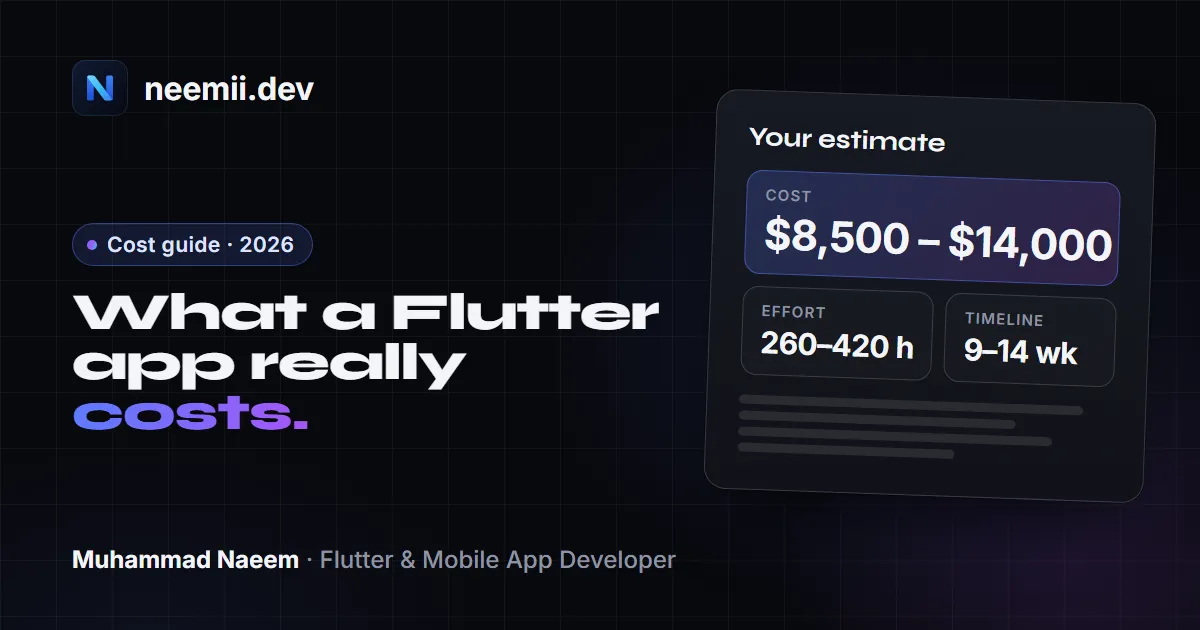
“How much will my app cost?” is the first question almost every founder asks, and the honest answer is “it depends.” That answer is useless on its own, so this post breaks it down. You will get the main things that drive cost, real hourly rates by region with sources, three example scopes priced out, and the running costs that show up after launch.
Every number below either links to its source or is labelled as an assumption. Where sources disagree, I give the range and say so.
The short answer
Cost is hours × hourly rate, plus running costs after launch. Hours depend on what the app does. The rate depends mostly on where your team is and whether it is a freelancer, a small studio or an agency.
For context, Clutch, which collects verified client reviews of development firms, reports that most mobile projects reviewed on its platform fall between $10,000 and $49,999, with an average project cost of about $90,780 and an average timeline of around 11 months. That average includes large projects. A GoodFirms survey from 2022 put a simple app at around $12,000. Your number can sit far above or below either figure, depending on scope.
What actually drives the cost
1. Number of screens and features
This is the biggest factor. A login screen, a profile and a list of items is a small app. Add search, filters, bookmarks, notifications, user roles and settings, and the hours multiply quickly. Each feature also needs its own design, error states, empty states and testing, not only the “happy path.”
2. Platforms
Do you need iOS, Android or both? With Flutter, one codebase covers both. With native development you build two apps, Swift for iOS and Kotlin for Android, which is close to two client-side projects. More on this below.
3. Backend and admin panel
Most apps need a server: user accounts, a database, file storage and business logic. You can use a managed backend such as Firebase or Supabase for simpler apps, or build a custom API for more control. Almost every business also needs an admin panel to manage users, content and orders. Founders often forget the admin panel when they budget, and it can be a project of its own.
4. Integrations
Each third-party service adds setup, edge cases and testing:
- Payments (Stripe, local gateways, in-app purchases): refunds, failed payments, receipts, and store rules.
- Maps and location: live tracking, geofencing, background location permissions.
- Chat and real-time features: message delivery, read receipts, typing indicators, media.
- Social login, push notifications, analytics, AI APIs.
Real-time chat and live location are among the most expensive features to build well. I have worked on them in apps like SheDrives, a ride-hailing app with live driver tracking and real-time bids, and DapUp, a location-based social app with live maps and messaging, and they always take more hours than the screen count suggests.
5. Design
Using a well-built component system with light customisation is cheaper than fully custom UI with complex animations. Custom design pays off for consumer apps where look and feel matter. For internal tools it usually does not.
6. Testing and launch
Testing on real devices, fixing bugs, preparing store listings, screenshots, privacy policy answers and handling App Store review take real time. Budget for it from the start instead of treating it as “the last few days.” (What that work involves: publishing a Flutter app on the App Store and Google Play.)
Where the hours usually go
This split is an assumption based on typical projects, not a measured industry figure. It varies a lot by app.
| Area | Share of total hours (assumption) |
|---|---|
| UI/UX design | 10–15% |
| Flutter app (both platforms) | 40–50% |
| Backend and admin panel | 20–30% |
| Testing and bug fixing | 10–15% |
| Project management and launch | 5–10% |
Hourly rates by region
Rates vary widely, and published data does not agree. Here is what the sources say, in USD.
| Region | Typical rate | Source |
|---|---|---|
| South and Southeast Asia (incl. Pakistan, India) | $24–$31 junior, $31–$41 senior | Accelerance, Nov 2025 |
| India (firms) | under $25 | Clutch, 2026 |
| Europe (incl. Central and Eastern Europe) | $31–$39 junior, $64–$76 senior | Accelerance, Nov 2025 |
| Poland / Ukraine (firms) | $50–$99 / $25–$49 | Clutch, 2026 |
| UAE (local agencies) | AED 200–350 ($55–$95) | Ptolemay, Aug 2025 |
| Australia (firms) | $100–$149 | Clutch, 2026 |
| United States (salary, not agency rate) | $64.44 median hourly wage | US BLS, May 2025 |
A few notes on this data:
- There is no reliable Pakistan-only survey. I could not find a current, published survey of Pakistani mobile developer rates, so the South Asia figures are the best available proxy.
- The UAE figure is from a vendor, not a survey. Treat it as a rough guide.
- US figures disagree. Clutch’s location table lists US firms at $25–$49 per hour, which is lower than most other guides. The BLS figure is what an employed developer earns, before the employer’s overhead and margin, so an agency rate will be higher. Agency guides commonly quote $100–$149 for US firms, but that is a secondary source citing Clutch data. I use $100–$150 below as an assumption for US agencies.
Cheaper per hour is not automatically cheaper per project. A senior developer at $40 who ships in 500 hours costs less than a junior at $20 who needs 1,200 hours and leaves you with code that is hard to maintain.
Three example scopes, priced out
The hour ranges below are assumptions for a Flutter app on iOS and Android. They include design, a backend, an admin panel where noted, testing and store launch. They assume a clear scope agreed before development starts.
Simple app: 250–450 hours (assumption)
- 5–10 screens
- Email or social login, profile, content lists and detail pages
- Managed backend (for example Firebase), basic admin via the backend console
- Push notifications, no payments
- Examples: a booking request app, a company content app, a simple utility
Medium app: 600–1,000 hours (assumption)
- 15–30 screens, two user roles
- Custom or managed backend plus a web admin panel
- Payments or subscriptions, push notifications
- One heavier feature: maps, chat or a third-party API
- Examples: a service marketplace MVP, a delivery app for one business, a membership app
With a fully custom backend and real-time chat, a medium app can reach about 1,200 hours.
Complex app: 1,400–2,500+ hours (assumption)
- 30+ screens, several user roles
- Real-time chat, live location, or both
- Custom backend, full admin panel with reporting
- Multiple integrations: payments, maps, AI services, external systems
- Examples: ride-hailing, social apps with real-time features, multi-vendor marketplaces
Cost table
Hours × rate. The rate bands are taken from the regional table above, with the US band labelled as an assumption.
| Scope | Hours | South Asia ($25–$40/h) | Eastern Europe ($35–$75/h) | UAE agency ($55–$95/h) | US agency ($100–$150/h, assumption) |
|---|---|---|---|---|---|
| Simple | 250–450 | $6,250–$18,000 | $8,750–$33,750 | $13,750–$42,750 | $25,000–$67,500 |
| Medium | 600–1,000 | $15,000–$40,000 | $21,000–$75,000 | $33,000–$95,000 | $60,000–$150,000 |
| Complex | 1,400–2,500 | $35,000–$100,000 | $49,000–$187,500 | $77,000–$237,500 | $140,000–$375,000 |
These are ranges, not quotes. The real number depends on your exact feature list, the team’s experience and how stable the scope is during the project.
My own pricing: a typical Flutter MVP with me costs about $5,000–$8,000. That sits at the low end of the South Asia band in the table, because I work as a solo developer and keep an MVP to the features it needs to launch. Larger scopes are quoted after we go through the feature list together.
Why Flutter usually costs less than two native apps
With native development, the iOS and Android apps are written separately. Every screen, every bug fix and every new feature is done twice and tested twice. Flutter uses one Dart codebase for both platforms, so most of that work is done once.
The savings are real, but not 50% of the whole project, because some work is shared either way: design, backend, admin panel, project management and store setup. My assumption for planning is that two native apps need roughly 1.6–1.9× the client-side hours of one Flutter app, while backend and design hours stay the same.
Published case studies point in the same direction, though they come from different contexts:
- Dow Jones’ MarketWatch game was built in Flutter by Very Good Ventures, who report a 50% cost reduction compared with building natively. This is the agency’s own case study and does not show how the figure was calculated.
- Supercell reduced the core code of Supercell ID by 45% with Flutter, even after adding desktop support.
- Zoho Tables reached feature parity with its web app in 14% less time.
Less code also means lower maintenance: one codebase to update, test and keep secure.
When Flutter does not save money
- You only need one platform. If your users are all on iOS, one native app may cost about the same.
- The app depends heavily on platform-specific features, such as home screen widgets, Apple Watch or Wear OS apps, CarPlay, advanced AR or unusual hardware SDKs. Flutter can do these through native code, but that part is written per platform anyway.
- You already have a strong native team and an existing native codebase. Rewriting a working app just to switch frameworks rarely pays off.
Costs people forget
Store fees
- Apple Developer Program: 99 USD per year, or local currency equivalent. Some nonprofits, schools and government bodies can get a fee waiver.
- Google Play developer account: 25 USD, one-time.
- Store commission on digital sales: If you sell digital content or subscriptions inside the app, Apple’s Small Business Program charges 15% for developers under 1 million USD in yearly proceeds. Google Play charges 15% on the first 1 million USD each year, and 15% on auto-renewing subscriptions. Physical goods and services, like food delivery or rides, generally go through your own payment gateway instead.
Servers and third-party services
Hosting, database, file storage, email, SMS, maps and AI APIs are billed monthly, usually by usage. Many services, including Firebase and Google Maps Platform, have free tiers that cover an early MVP. Costs then grow with your user count. Ask your developer for a monthly running-cost estimate at 1,000, 10,000 and 100,000 users before you commit to an architecture.
Maintenance
The most common rule of thumb is that yearly maintenance costs 15–20% of the original build cost. Cleveroad attributes this figure to CISQ, though I could not find the primary CISQ study, and other vendor guides quote higher numbers. Treat it as a planning heuristic, not a measured fact. On a $40,000 app, that means budgeting roughly $6,000–$8,000 a year.
Updates for new OS versions
This is not optional. Both stores force regular updates:
- Since April 28, 2026, apps uploaded to App Store Connect must be built with Xcode 26 and the iOS 26 SDK.
- From August 31, 2026, new apps and updates on Google Play must target Android 16 (API level 36), and existing apps targeting old API levels stop being available to new users on newer Android devices.
Every year, someone has to update the app, its packages and its build tools, then test it again. With Flutter, that is one codebase instead of two.
How to cut cost without hurting quality
Start with a real MVP
An MVP is the smallest version of the app that proves people will use it or pay for it. Write down the one main job your app does. Every feature that does not support that job goes to a “later” list. Most first versions do not need an in-app chat, a referral system or five login options.
Launch in phases
Phase 1 is the core flow and a basic admin panel. Phase 2 adds what real users ask for. This spreads the cost, and the second phase is based on data instead of guesses.
Use managed services
Firebase, Supabase, Stripe and similar services remove weeks of backend work in the early stages. You can move to a custom backend later if scale or cost requires it.
Keep design simple, not cheap
A clean, consistent design built from a small component set looks professional and is faster to build than a unique layout on every screen. Spend the custom design budget on the screens users see most.
Fix the scope before development
Changing direction halfway through is the most expensive thing you can do. A short paid discovery phase, with clickable wireframes and a feature list, usually saves more than it costs.
Do not choose on hourly rate alone
Ask for past apps that are live in the App Store and Google Play, and download them. Ask who will maintain the app after launch. A slightly higher rate from someone who has shipped similar apps is often the cheaper option overall.
A real example: one of my projects was a crime reporting system for a police service. It had two apps. The police app received complaints, issued warnings, listed wanted persons, and managed complaints and officers. A separate public app let citizens file complaints. Both apps, the backend and a website came in at roughly $5,000–$8,000. That was possible because the scope was clear before development started, and both apps shared one backend and one design system.
Get your own estimate
If you want a rough number for your idea, try the free app cost calculator. Pick your features, platforms and region, and it gives you an hour and cost range based on the same assumptions as this post.
For a real estimate, send me your idea. I am Muhammad Naeem, a Flutter developer in Lahore building iOS and Android apps for startups in the UAE, Pakistan and worldwide. Tell me what the app should do, and I will reply with a scope, a timeline and a price range, free and with no obligation.
Need a Flutter app built? Tell me about your project, or see case studies of apps I’ve worked on.