
Who this is for
- Founders building an AI-first app, where the AI feature is the product: an assistant, a creative tool, a smart search.
- Teams with an existing app that want to add an AI feature, such as chat, summaries, image tools or smarter search, without rebuilding the app.
- Businesses testing an AI idea that want a working app in users’ hands to see whether it’s worth more investment.
What you get
- A scoped AI feature, not a demo. We define what the model gets as input, what the user sees, and what happens when the answer is slow, wrong or empty.
- Model and provider choice between OpenAI, Gemini and Claude, based on what the feature needs, with prompts written and tested against real examples.
- A backend for the AI calls on Firebase or Node.js, so API keys stay on the server, usage can be limited per user, and you can change the model later without an app update.
- The mobile app around it: sign-in, history, file and image upload, cloud storage, push notifications and the in-app UI for streaming answers or long-running jobs.
- Store release: store listing, App Store and Google Play review, crash monitoring and analytics.
Everything else about the build, from Figma prototype to weekly test builds, works the same way as my Flutter app development projects.
AI features I build
- LLM chat and writing tools: assistants, caption and content generators, summaries, structured output for your app’s own screens.
- Image generation and editing: text-to-image, background removal, photo restoration, image-to-video and file conversion through cloud AI pipelines.
- AI search and matching: finding the right people, products or content from a plain-language request.
- Computer vision: features that read and understand photos taken in the app.
How the work runs
- 01 · Discover (3–5 days). Goals, users and the AI feature in detail, then scope, tech stack, timeline and a fixed quote.You get: project brief and estimate
- 02 · Design (1–2 weeks). User flows, wireframes and UI in Figma, including the loading, error and retry states AI features need.You get: approved Figma prototype
- 03 · Build (4–10 weeks). Clean Architecture Flutter app and backend in weekly sprints, with a fresh TestFlight or Play test build every week.You get: release-ready iOS and Android build
- 04 · Launch (1 week + support). Store listing, App Store and Google Play review, crash monitoring and analytics, and support as real users arrive.You get: live on App Store and Google Play
Tech stack
- AI: OpenAI, Gemini, Claude API, prompt engineering, computer vision.
- App: Flutter and Dart, with Kotlin and Swift for native work; Bloc, Provider or GetX on Clean Architecture.
- Backend: Firebase (Auth, Firestore, Storage, FCM), Supabase, Node.js, Google Cloud, AWS, REST and GraphQL APIs.
AI apps I’ve shipped
Evoke AI: an AI creative studio
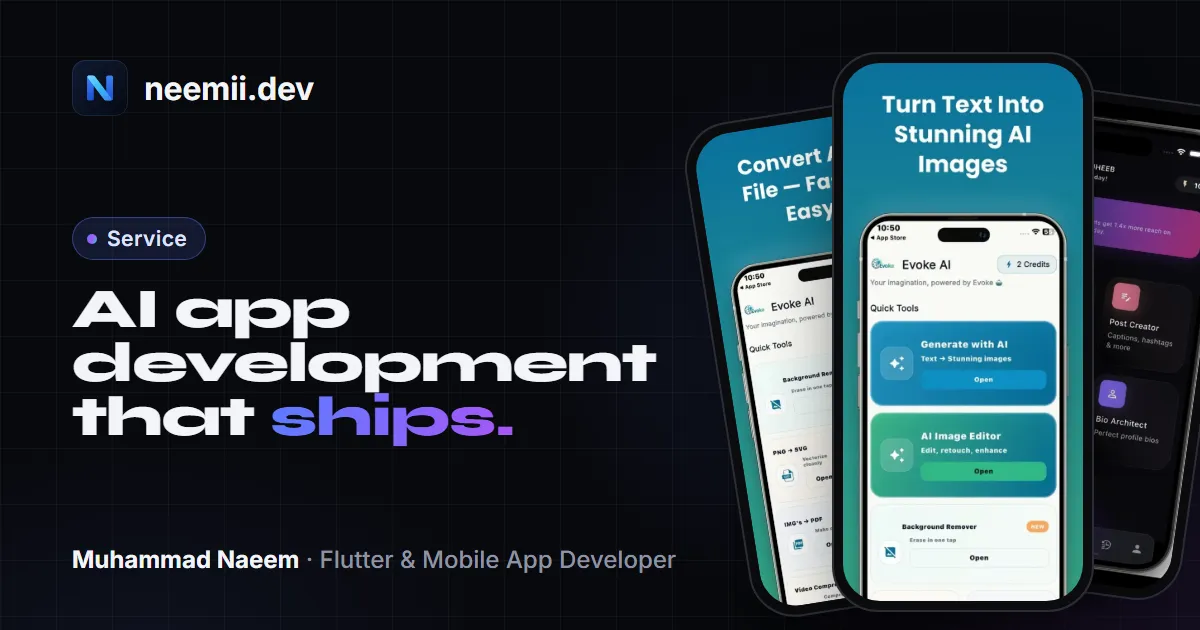
An AI creative studio in your pocket — generate, edit, restore and convert images and files with cloud AI pipelines, from background removal to text-to-image. Features include AI Image Generation, Background Removal, Photo Restoration, File Conversion, Image-to-Video. My part: Co-built with one other developer: in-app purchases, ads, AI photo editing, web tools, file converters and QA.(★ 4.9 on the App Store.) Read the case study, or see what an AI photo app costs to build and run.
Hashtag AI Expert: a social media toolkit for creators
A social media growth tool for Instagram and TikTok creators: an AI hashtag generator, profile audits, engagement and growth analytics, and personalised growth suggestions, with credit packs and Arabic support. Built with Flutter, OpenAI GPT, Firebase, In-app purchases. Read the case study.
Inlinker: a creator marketplace
A marketplace where brands find the right content creators and influencers — AI-powered search, direct messaging, job posts and secure escrow-style payments. My part: Bug fixes and improvements to the Flutter app. (★ 4.5 on the App Store.)
Questions
Which AI model should my app use?
It depends on the feature. Chat and writing, image work and vision each have different strengths, prices and speeds across OpenAI, Gemini and Claude. In discovery I test the feature with your real examples and recommend one. Because the calls go through your backend, switching later doesn’t need a new app release.
Will my API keys be safe?
Keys are kept on the server, not inside the app, where they could be pulled out of the install file. The app talks to your backend, and the backend talks to the AI provider.
How long does an AI app take?
The same phases as any app: 3–5 days of discovery, 1–2 weeks of design, 4–10 weeks of build and about a week to launch. Adding one AI feature to an existing app is usually a smaller job; you get a timeline and fixed quote after discovery. The app cost calculator gives a rough first number.
Can we work across time zones?
Yes. Lahore is one hour ahead of the UAE, and I’ve worked remotely with a Dubai company before. Elsewhere, we agree a fixed overlap for calls, and you test a new build every week.
Do you sign NDAs?
Yes. AI ideas are often easy to copy, so send your NDA with your first message and we sign it before you share details.
What about after launch?
AI providers change models and prices often, so AI apps need more care than most. I can stay on to update models, tune prompts and add features; see app maintenance and support.
Have an AI app idea?
Tell me what the AI should do for your users. I reply within 24 hours with first questions and ideas, then we can do a free 30-minute discovery call and you get a plan with a fixed quote.